

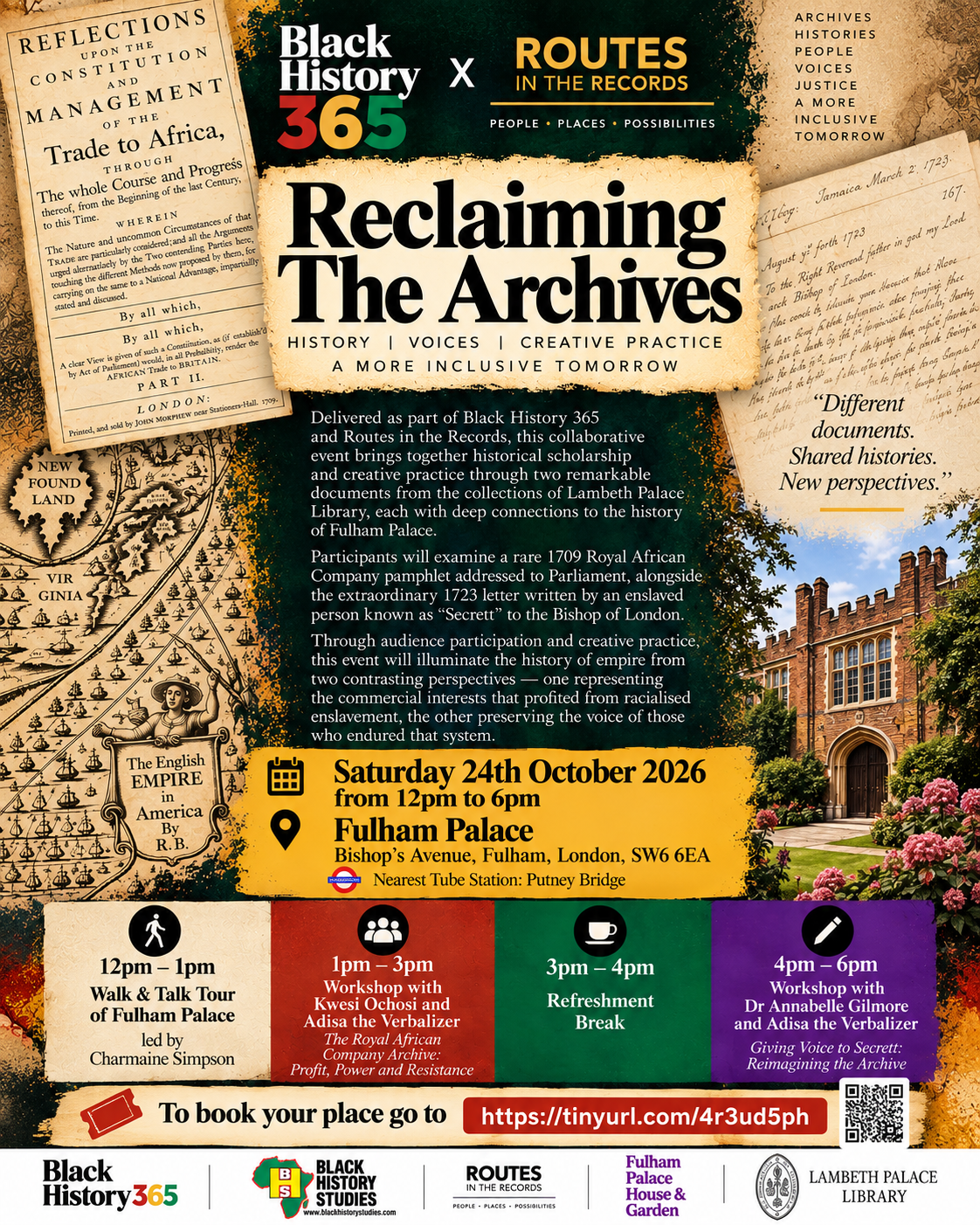
Black History 365 x Routes In The Records: Reclaiming The Archives at Fulham Palace
Delivered as part of Black History 365 and Routes in the Records, this collaborative event brings together historical scholarship and creative practice through two remarkable documents from the collections of Lambeth Palace Library, each with deep connections to the history of Fulham Palace.
Participants will examine a rare 1709 Royal African Company pamphlet addressed to Parliament, alongside the extraordinary 1723 letter written by an enslaved person known as “Secrett” to the Bishop of London. Through audience participation and creative practice, this event will illuminate the history of empire from two contrasting perspectives – one representing the commercial interests that profited from racialised enslavement, the other preserving the voice of those who endured that system.
Programme
12pm – Walk & Talk Tour of Fulham Palace
Led by Charmaine Simpson, the tour will introduce participants to Fulham Palace’s historic links with colonialism, the Church of England and the transatlantic world. It will explore the Palace’s current interpretation of its colonial connections, exhibitions examining the Bishops of London’s relationship with enslavement and empire, and the significance of the Fulham Papers as one of Britain’s most important ecclesiastical archives. The tour will provide the historical context for the day’s workshops and introduce participants to the institutional world in which both the Royal African Company and Secrett’s letter intersect with the history of the Bishops of London.
1pm – Workshop with Kwesi Ochosi and Adisa the Verbalizer
Title: The Royal African Company Archive: Profit, Power and Resistance
Drawing on a forty-four-page Royal African Company pamphlet published in 1709 and preserved at Lambeth Palace Library, Kwesi Ochosi will guide participants through one of the most revealing documents relating to Britain’s early involvement in the racialised chattel enslavement of African people.
Working with reproduced pages from the original pamphlet, Adisa the Verbalizer will lead participants in making bold creative interventions directly into the text. By obscuring sections of the colonial narrative and allowing new words, phrases and meanings to emerge, participants will create powerful poetic responses that reclaim space within the archive and give voice to the African people whose resistance,
resilience and humanity are only partially visible within the historical record
3pm – Refreshment Break
An opportunity for participants to chat, network, grab a drink and a bite to eat, and
reflect on the afternoon’s discussions before the final workshop.
4pm – Workshop with Dr Annabelle Gilmore and Adisa the Verbalizer
Title: Giving Voice to Secrett: Reimagining the Archive
Centred on the 1723 letter written by an enslaved person known as “Secrett” to the Bishop of London, this interactive workshop invites participants to engage with one of the most powerful first-person testimonies preserved within the Fulham Papers. Guided by Dr Annabelle Gilmore, participants will explore the historical context of the letter and examine what it reveals about agency and within the structures of the British Empire.
Building on this historical interpretation, Adisa the Verbalizer will lead participants in a series of creative responses that bring Secrett’s words into dialogue with the present day. Through spoken word, creative writing and collaborative zine-making, participants will be encouraged not simply to read history but to respond to it, with new narratives that connect archival evidence with contemporary ideas about justice and belonging.
Why Fulham Palace?
As the historic home of the Bishops of London, Fulham Palace occupies a unique place within the history of the Anglican Church, the British Empire and the wider Atlantic world. Together with the collections of Lambeth Palace Library, its archives provide exceptional opportunities to explore Britain’s entanglement with colonialism, enslavement and the transatlantic world.
The 1709 Royal African Company pamphlet and Secrett’s 1723 letter offer two contrasting but deeply interconnected perspectives on this history. By combining archival research with creative interpretation and community participation, Fulham Palace provides an ideal setting to explore how historical records can become living resources for education and empowerment. In the context of reparative justice for the legacies of racialised transatlantic chattel enslavement, this event also highlights the importance of collaborative partnerships between heritage organisations, researchers, artists and communities in making archival collections more accessible, inclusive and relevant to contemporary audiences.
Learn about the Church Commissioners’ links with transatlantic chattel enslavement and the significant records held in the archive.
This is a chance to connect with history, reflect on the Church of England’s Black History, and see how the past is preserved for future generations.
THIS EVENT IS NOT TO BE MISSED!!
This event will take place on Saturday 24 October 2026 from 12:00 to 18:00.
The event will be held at Fulham Palace, Bishop’s Avenue, Fulham, London, SW6 6EA. Nearest Tube Station: Putney Bridge. For more information about travel to the venue, click here
Admission is FREE.
To book your FREE ticket, go to https://tinyurl.com/4r3ud5ph
Please note that this event will be photographed for historical record and uploaded to the World Wide Web. By attending and participating in this event, you are giving your consent to be photographed and waiving any and all claims regarding the use of your image.